Published: 2025-08-29
A wave of fresh academic voices from Hong Kong Baptist University (HKBU) took center stage at the International Association for Media and Communication Research (IAMCR) 2025 Conference, held from July 13 to 17 at Nanyang Technological University (NTU), Singapore. More than 30 Research Postgraduate students from the School of Communication presented their papers across over 300 sections and working group sessions, showcasing award-winning research and innovative work in organizational communication, political communication, journalism research, digital media studies, human-AI interactions and integration.
 |
Daya Thussu giving his opening address at the IAMCR 2025 Conference |
In his opening address, Daya Thussu, President of IAMCR and Professor in HKBU’s Department of Journalism highlighted the conference as a platform for intercultural dialogue and intellectual exchange and emphasized the importance of nurturing emerging scholars in shaping the future of global media and communication research. “As communication scholars, it is our responsibility, to not only contribute to the intellectual community, but also to think about potential solutions to existential issues and to provide voices that might positively influence policies”, he remarked.
Narrating Resistance with Cultural Journalism
Shivangi Asthana (4th Year RPg Student) studies the complex interactions between religious identity, state power, media censorship and civic resistance, focusing on how evolving social movements redefine and contest the boundaries of religious and journalistic freedom. Asthana’s on-going research presented in the Journalism Research and Education Section at the 2025 IAMCR conference delved into the evolving role of journalism in empowering community-driven efforts and grassroot social movements.
 |
Shivangi Asthana (left) at the IAMCR Conference |
In her presentation titled ‘Cultural Journalism as a Tool for Global Citizenship’, Asthana, emphasized how media can critique dominant global narratives and encourage citizens to actively participate in social change. She aims to develop a framework that elevates cultural journalism as a tool for amplifying marginalized voices and fostering inclusive public discourse. She argued that spotlighting grassroot movements like citizen journalism, environmental activism, and campaigns against systemic injustices is essential for breaking down stereotypes, promoting media literacy, and strengthening democratic participation.
Corporate Communication and Human Rights
Hua Li (3rd year RPg student), who researches strategic communication, corporate social responsibility, and crisis management, is curious about how organisations communicate human rights performance through environmental, social, and governance reporting. In the paper titled ‘Unveiling the Underlying Tensions in Chinese Corporate Discourse on Human Rights: A Circuit of Culture Perspective,’ co-authored with Angela Mak (Associate Professor, Department of Communication Studies) and presented at the IAMCR conference’s Ethics of Society and Ethics of Communication Working Group, Li and Mak explored the evolving narratives and power dynamics embedded in corporate messaging around human rights and examined how corporate discourses on human rights are constructed in China.
 |
Angela Mak and Hua Li presenting their paper at the IAMCR Conference |
Their research investigates how Chinese tech companies like Lenovo and Xiaomi construct their human rights narratives to gain legitimacy while navigating global expectations. Li and Mak revealed several underlying tensions within corporate discourse. For example, both companies hold strong positions in the value chain, allowing them to transfer responsibility to suppliers, while rarely addressing internal human rights issues. They also noted that, due to shifting norms and public pressure, narratives around human rights are evolving, such as shifting the emphasis from technology accessibility to AI ethics.
Media Effect and Para-social Dynamics in Political Communication
Li’s award-winning second paper, co-authored with Yuexin Lyu (3rd Year RPg Student) explored the relationship between political news consumption, political knowledge, and affective polarization. The paper titled ‘Skewed Likes and Dislikes: Examining Affective Polarization in Chinese Attitudes Toward Russia and the US’ was awarded the Outstanding Early Career Paper by the Political Communication Research Section at the 2025 IAMCR conference.
 |
Hua Li receiving the award for his paper co-authored with Yuexin Lyu |
In the paper, Li and Lyu examined how Chinese internet users’ consumption of political news and their level of political knowledge influence their attitudes toward Russia and the United States. They found that increased exposure to political news is associated with higher levels of political knowledge and stronger affective polarization. The findings highlight how media exposure and knowledge shape emotional biases and national attitudes, offering insights into how global narratives influence domestic perceptions.
Another study co-authored by Zuquan Xiong, Tianlun Zhou, and Fangyuan Liu (4th Year RPg Students) whose research interests span the broader areas of digital journalism, identity politics, and political communication, further extended the understanding of media effect and para-social relationships by studying how audiences relate to media figures. In their paper titled “A Person, A Worker, and An Officer: Understanding the Public Sense-making of Political Media Persona”, presented in the Audience Section at the IAMCR conference, the authors argued that para-social relationships are shaped by tensions and contradictions arising from media audience heterogeneity, multiple identities of media performers, and varied interpretations of these dynamics.
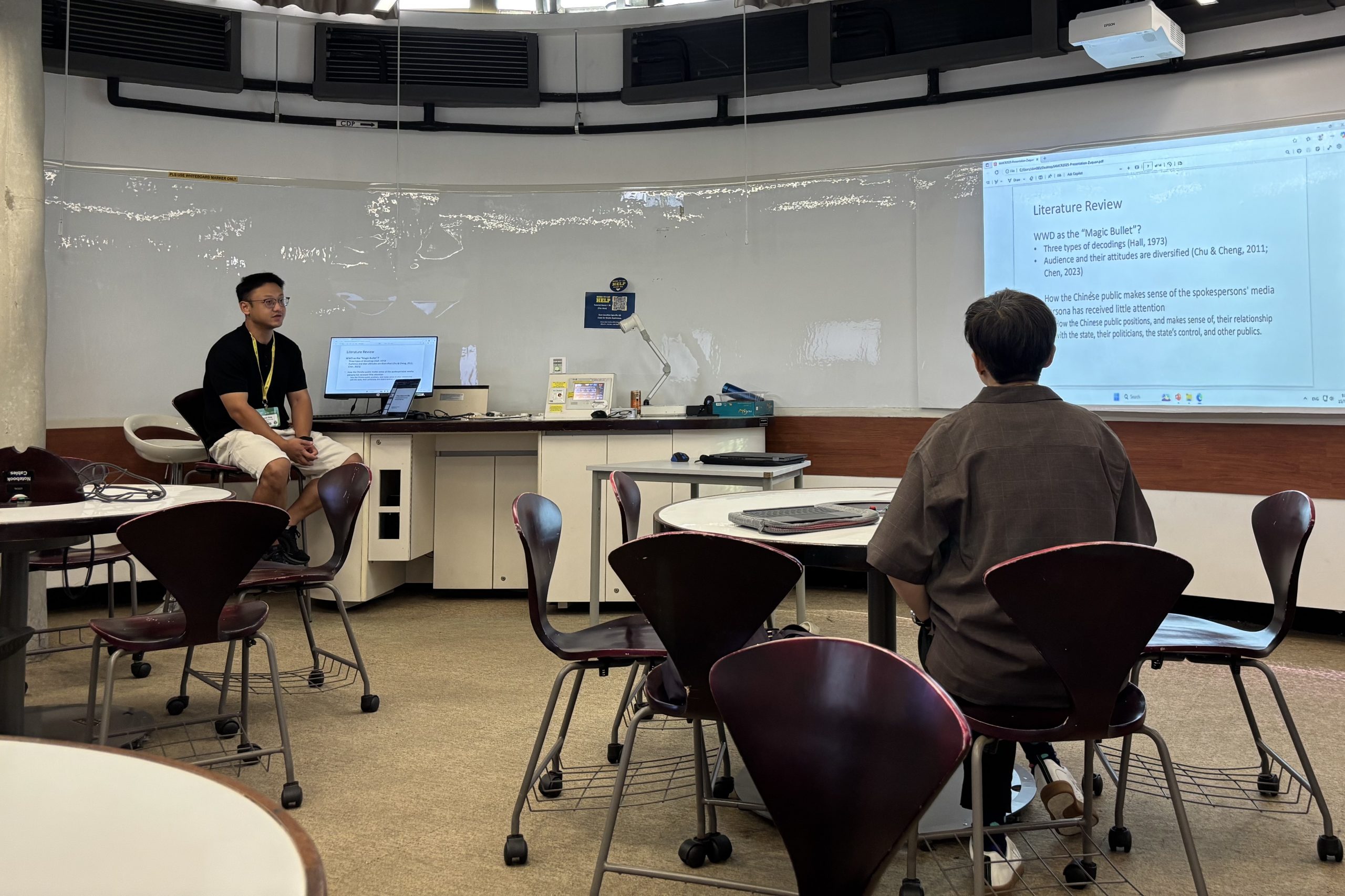 |
Zuquan Xiong at the IAMCR Conference |
Exploring this phenomenon within the Chinese context, Xiong, Zhou, and Liu examined how Chinese citizens interpret the public image of Ministry of Foreign Affairs (MFA) spokespersons, who have become political idols through stylized “wolf-warrior” diplomacy videos on social media. They identified three dialectical tensions: Amiable–Authoritative (balancing nationalistic appeal with official responsibility), Spontaneity–Programmed (personal disclosure versus professionalism), and Authentic–Performative (authenticity versus role expectations). These findings reveal audience’s nuanced and sometimes contradictory perceptions and highlight their awareness of the performative nature of political personas.
Human-AI Relationships and AI-Mediated Communication
Focusing on the dynamics of Human-AI interaction and the perceptions of AI agents, Hongyuan Gan, Jiawei Dai, and Mengyao Liu (2nd Year RPg students) presented their paper in the Mediated Communication, Public Opinion and Society Section at the IAMCR conference titled “Exploring the Integrative Heuristic Processing in Human-AI Relationships and Their Impact on Users’ Undersociality: A Perspective of Expectancy Violation and Confirmation”. In the paper, the authors explore how heuristic processing, cognitive shortcuts used to make judgments, shapes human-AI relationships. They argue that relying solely on one heuristic framework may oversimplify the complex dynamics of human-AI interaction.
To investigate these dynamics, Gan, Dai and Liu conducted interviews with 26 participants who had experience with AI and social anxiety, analyzing their responses to uncover patterns in perception and behavior. They found that users often form expectations about AI based on different heuristics and often train AI to meet these expectations. They also observed that users respond more favourably when AI violates their expectations positively, such as showing unexpected empathy, than when their expectations are merely confirmed. The authors emphasize the potential of AI to support emotional well-being and social competence.
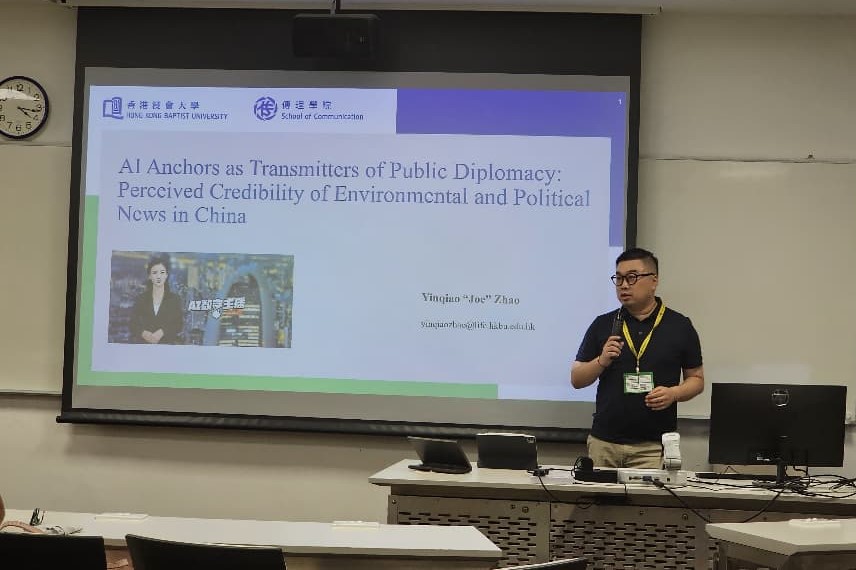 |
Yinqiao Zhao presenting his paper at the IAMCR Conference |
Yinqiao Zhao (3rd Year RPg Student) presented his ongoing research in the International Communication section at the IAMCR conference. His paper, titled “AI Anchors as Transmitters of Public Diplomacy: Perceived Credibility of Environmental and Political News in China,” analyses the role of Chinese AI news anchors in disseminating state narratives, particularly in the context of political and environmental reporting. Zhao aims to explore how media audience evaluate the credibility of news delivered by AI journalists compared to their human counterparts in China. By examining both environmental and political reporting, Zhao’s research will shed light on the evolving role of AI in shaping public diplomacy and media trust among Chinese and international audience.
Other research postgraduate students in the School of Communication who presented their papers across various sections at IAMCR this year include Yujia Chen, Li Qiqi, Richard Sam Dickson, Abdulwahab Tahhan, Xu Yan, Wang Xinyue, Wang Yichen, Xiangning Hong, Ziyu Feng, Zhang Yuhao, Yanjing Lu, Mariyam. Manik, Arjun Chatterjee, Lijun Luo, Liu Dandan, Li Zixi, Zhuang Huijun, Xia Xiaoyu, Yuchen Zhou, Wanhui Zhou, Yang Shengzhe, and Yang Sihao. Their contributions reflect a growing commitment to interdisciplinary inquiry and global dialogue on pressing communication issues.
